


ABOUT PACKAGING
This information aims to be an introduction tool to the world of corrugated cardboard and thus make the reader aware of its history, its production process, characteristics and benefits.
The reader will develop basic knowledge for making decisions regarding their corrugated cardboard packaging, as well as the quality aspects to consider in it and what will best help the image of their brand.


What is corrugated cardboard?
Corrugated cardboard is a material that is based on cellulose, it is formed by a central nerve called a flute or medium, which has a corrugating process to create volume. This rib is reinforced by two external papers called liners or faces that are glued with adhesives to the crests of the flute's wave.
Corrugated cardboard sheets are a lightweight material that generates great resistance thanks to the work together of these three sheets of paper. There are different types of corrugated such as double corrugated and triple corrugated that provide us with greater resistance.

Composition of corrugated cardboard
Corrugated cardboard is mainly composed of three papers: one: central called flute or medium and two external faces/liners
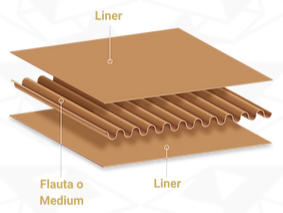
The properties, characteristics and benefits of corrugated cardboard are given by its structure. Starting from the base structure, there are ways to work with corrugated cardboard, each of them is the evolution of the previous one, as shown below:
• Single face:It is formed with a smooth side and a corrugated side, which are joined together with adhesive. This constitutes the fundamental unit of all corrugated cardboard
•Simple corrugated or simple wall:Adding a second face to the previous one, makes it a double face, with 2 tops and a wave in the middle
•Double corrugated or DD:It is achieved by adding another single face module, with 3 covers and 2 waves
•Triple corrugated: With 4 covers and 3 waves, we combine a DD with a single face
History of corrugated cardboard
In the timeline, corrugated has packaged our goods since long before the advent of airplanes or automobiles. Its colorful past provides corrugated with the stability to fuel its use in the future. The history of corrugated has given us the best possible packaging, which creates unlimited opportunities for innovation to meet the challenges that history still has to come.

What is a flute?
It is the internal structure in a sheet of corrugated cardboard, and it is the part thate provides resistance, strength, rigidity and cushioning to the box when handling. Due to these characteristics, corrugated cardboard is an ideal material for transporting and protecting products. The flute is made up of: ridges, which are the upper parts of the corrugation with respect to the outer liner (the impression is made on the ridges), valley, which refers to the lower parts of the corrugation. These commonly cause lines that are not always covered in the print due to the distance between crest and crest.
TYPES OF FLUTE.

CORRUGATED CARDBOARD PRODUCTION PROCESS.


Before carrying out a series production process, it is important to make prototypes of the packaging to be manufactured. This is known as a "sample."
Which is a full-size physical representation of the box design, and serves as a guide for improvements in structure and strength.
If the box has printing, it is important to provide all the specifications such as logo, content, barcode, nutritional tables, stowage legends², export or any essential element that the box must contain.
Thus, the distribution of graphics is taken into account to ensure the best brand image. Another important point to consider is whether the box will have a specific treatment and/or coating; These are applied as additional treatments such as an ideal coating to prevent moisture from penetrating or to withstand the absorption of water, waxes, glues or resins a little longer.
The purpose of these applications is to add resistance properties to the boxes. The quality department is responsible for supervising that all treatment and/or coating is well placed since the application must be uniform and pass functional tests, which can be: immersion in water, COBB4 test, among others.
What is taken into account when designing packaging?
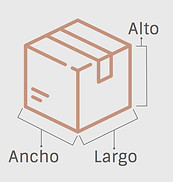
To develop a box properly, it is necessary to analyze the characteristics of the product to be packed (material, size, shape, etc.) and the number of pieces it will contain. The interior measurements of the box are one of the basic and fundamental elements for the design and manufacturing, the correct way of nomenclature of these measurements is: Length x Width x Height.

IMPORTANT NOTE Considerations for developing a box To make the ideal box/packaging, it is necessary for the client to share all the basic information about their product to the experts. This will help understand the customer's needs and ensure product protection, coupled with an ideal presentation.
Packaging function
Packaging is everything necessary in the process of conditioning the products to protect them, and/or grouping them temporarily thinking about their handling, transportation and storage.
One of the functions of good packaging is to "communicate."
What are we referring to? You can tell us if what it contains is a delicate product or not, which company transports it, among others. However, clients often do not know how to send their art to be printed on their box, here we tell you the most common mistakes and the ideal way to send your graphics. THE IDEAL
• Provide as much product information as possible to determine the best fit or material, including whether some type of insert is required to protect the product.
• Be open to receiving proposals for improvement, both structural and design and graphic.
• Specify what the packaging will contain in order to determine what resistance and flute to use for it.
• Logo in vector or editable file
• Specify the type of barcode or, failing that, the editable file
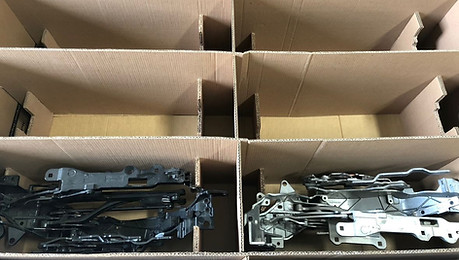
Inserts (Partitions or dividers).
They provide a separate cell for each item in a box and are mainly used for crystal, glass bottles, earthenware or other fragile items. There are inserts that serve the function of separating the pieces inside the box, as is the case with glass bottles that contain separators.s so that the bottles do not rub against each other and thus avoid wear on the labels or even breakage of any part, and separators that go from the base to the lid giving a greater contribution to the resistance of the boxes. There are countless inserts, which will be attached according to the product that needs to be protected, but we mainly find these types:


